
Your competitors are digitizing their documents. Some are succeeding spectacularly. Most are failing quietly. The gap between those two outcomes has almost nothing to do with technology — and everything to do with five predictable mistakes that are repeated endlessly across industries.
The 80% Problem
Industry research consistently shows that between 70–85% of document digitization initiatives either fail outright, stall mid-project, or deliver results so poor that the investment cannot be justified. This is not because digitization is inherently difficult. It is because the same five failure modes appear over and over, in companies of every size and sector.
Understanding these failure modes before you start is the single most valuable thing you can do to protect your investment.
The 5 Fatal Mistakes
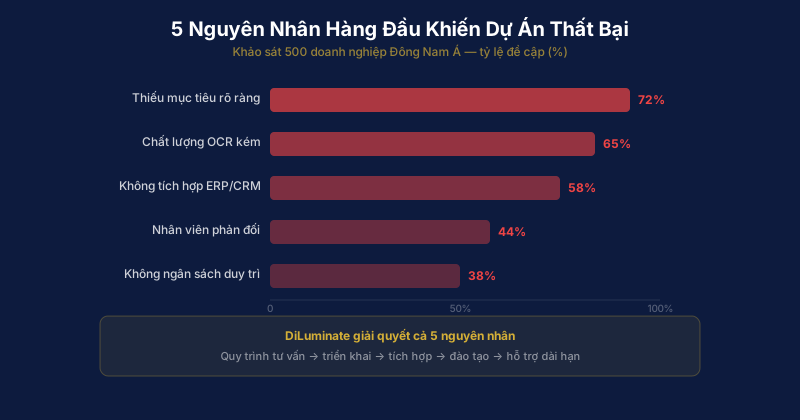
1. No Clear, Measurable Goals (72% of failures)
"We want to digitize our documents" is not a goal — it is a wish. Projects that fail almost universally start without defining what success looks like in specific, measurable terms. How many documents? By when? What will the data be used for? Which systems will it connect to? Without answers, the project drifts until it dies.
2. Accepting "Good Enough" OCR Quality (65% of failures)
Off-the-shelf OCR tools market themselves with impressive-sounding accuracy claims. What they don't advertise: 95% accuracy means 50,000 errors per million records. When those errors flow into your ERP, CRM, or financial systems, the cost of correction exceeds the cost of the original project. More on this in our next article.
3. No Plan for System Integration (58% of failures)
Digitized documents that live in a standalone system — disconnected from your operational workflows — deliver roughly 15% of their potential value. The transformation happens when digital data flows into the systems your people already use. Projects that don't architect for integration from day one always regret it.
4. Underestimating Staff Adoption (44% of failures)
Technology is the easy part. People are the hard part. Employees who built their workflows around paper processes will resist change actively or passively unless they are brought into the process early, trained properly, and shown clear personal benefit from the transition.
5. No Budget for Ongoing Maintenance (38% of failures)
Digitization is not a one-time project — it is an ongoing capability. New documents arrive daily. Formats change. Regulations update. Systems evolve. Projects that treat digitization as a one-off deployment rather than an operational capability find themselves back to square one within 18 months.
What the Successful 20% Do Differently
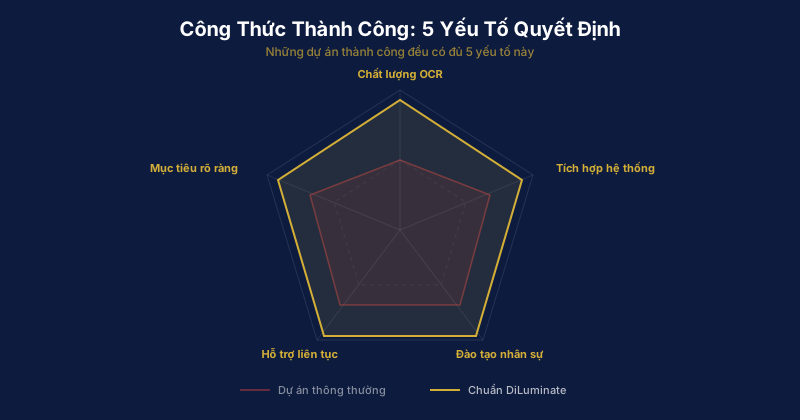
Without exception, the successful 20% share five characteristics: they define precise goals before starting, they insist on enterprise-grade OCR accuracy, they design for system integration from day one, they invest in structured change management, and they budget for digitization as an ongoing operational function rather than a project.
The DiLuminate Difference
DiLuminate's methodology was built specifically to eliminate all five failure modes. Before any scanning begins, our consultants work with you to define clear success criteria, integration requirements, and adoption plans. Our technology achieves 99.7% accuracy with multi-layer quality assurance. Our project delivery includes staff training and handover to your team. And our support model ensures your digitization capability continues to deliver value long after project close.
We have successfully delivered digitization projects for enterprises across manufacturing, finance, healthcare, and legal sectors. In every case, the difference was not technology — it was process discipline and partnership quality.
Is Your Project Set Up to Succeed?
Before you commit to any digitization initiative, run through the five failure modes above. If you cannot answer each one with confidence, that is where to focus first. DiLuminate offers a free Project Readiness Assessment that evaluates your organization against all five dimensions and gives you a clear picture of where to invest attention before work begins.
Contact us today for a free assessment — and make sure your project lands in the 20%.