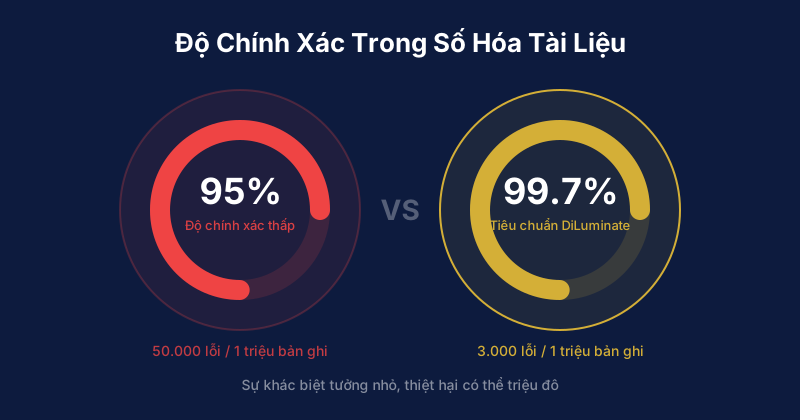
"Our system achieves 99% accuracy." It sounds impressive. But in a company processing 1 million document records per year, that means 10,000 errors flowing into your systems — every single year. Would you accept 10,000 errors in your financial data? In your customer records? In your compliance documentation?
The Accuracy Illusion
The document digitization industry has a accuracy-reporting problem. Vendors measure accuracy on curated test sets under ideal conditions, then report those numbers as if they apply to real enterprise document volumes — which include poor scan quality, handwriting, faded ink, mixed formats, and non-standard layouts.
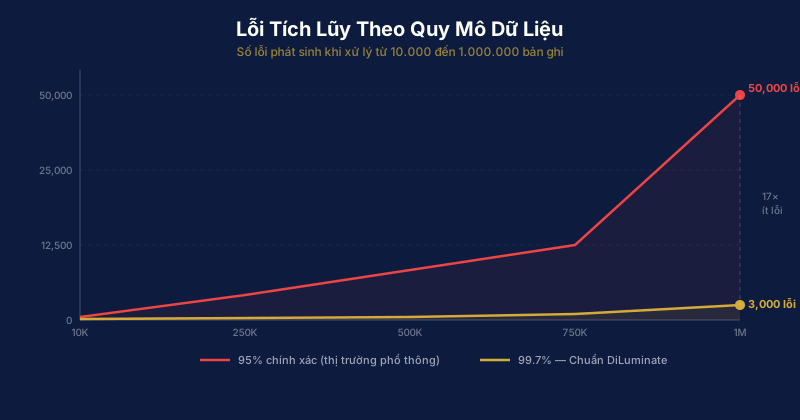
When accuracy is measured on real enterprise documents under real conditions, the gap between vendors widens dramatically. And the impact of that gap is not linear — it compounds as scale increases.
What Each Error Actually Costs
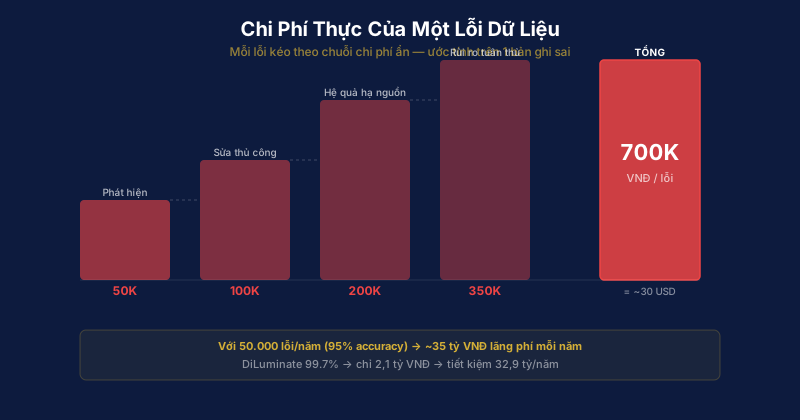
An error in digitized data is never just an error. It triggers a cascade:
- Detection cost: Someone must identify that an error exists — often through a downstream failure rather than proactive checking.
- Manual correction cost: A human must find the original document, verify the correct value, and update the system — typically 20–30 minutes per error.
- Downstream impact: Data that flowed from the erroneous record to other systems must also be corrected — multiplying the work.
- Compliance risk: In regulated industries, a single erroneous record can trigger audit findings, penalties, or legal liability that dwarf the correction cost.
Conservatively estimated, each erroneous record costs 600,000–800,000 VNĐ to resolve. At 50,000 errors per year (95% accuracy on 1M records), that is 30–40 billion VNĐ in annual error resolution costs.
Why Most Vendors Cannot Hit 99.7%
Achieving 99.7% accuracy on real enterprise documents requires several capabilities that most vendors simply do not have: AI models trained specifically on Vietnamese and multi-language business documents; multi-pass OCR with confidence scoring; automated quality validation against known patterns and constraints; and human-in-the-loop review for low-confidence extractions.
Standard off-the-shelf OCR engines are general-purpose tools. They have not been trained on the specific document types, layouts, and language characteristics of Vietnamese enterprise documents — contracts, invoices, permits, financial statements, HR records. The accuracy degradation on these documents compared to standard English text is substantial.
The DiLuminate 99.7% Standard
DiLuminate's accuracy guarantee is built on a four-layer quality assurance pipeline:
- AI-Powered OCR: Models fine-tuned on Vietnamese enterprise document types achieve higher baseline accuracy than generic engines.
- Confidence Scoring: Every extracted character and field receives a confidence score. Low-confidence extractions are flagged automatically for review.
- Rule-Based Validation: Extracted data is validated against business logic — formats, ranges, cross-field consistency. Invalid combinations are caught before delivery.
- Human Review Layer: Flagged extractions are reviewed by trained QA specialists, ensuring that no uncertain data passes to your systems unchecked.
This pipeline is what separates 99.7% from 95% — and 3,000 errors from 50,000.
Calculating Your Accuracy ROI
Before choosing a digitization provider, ask them to provide accuracy figures on documents similar to yours — not on their test set. Then calculate: at their accuracy level, how many errors will you receive per year? What will those errors cost to resolve? The math usually makes the higher-quality provider the obvious economic choice, even at a higher initial price.
DiLuminate is happy to run this calculation for your specific document volumes and types. Contact us for a free Accuracy Impact Analysis — we will show you exactly what the accuracy difference means in dollars and dong for your business.