
Imagine hiring a full-time employee who spends their entire day doing nothing but printing, filing, searching for, and re-printing documents. Now imagine having three of them. That is exactly what most medium-sized businesses are doing — they just don't see the salary on any single payslip.
The Problem No One Talks About
Paper-based document management is one of the most silently expensive practices in modern business. Unlike salaries or rent, these costs hide across departments, job roles, and budget lines — making them nearly invisible to even the most diligent CFO.
Research by AIIM (Association for Intelligent Information Management) found that organizations spend an average of $20 to store a single document, $120 to find a misfiled document, and $220 to reproduce a lost document. Multiply that across thousands of documents a year, and you begin to see the iceberg beneath the surface.
Where Your Money Is Actually Going
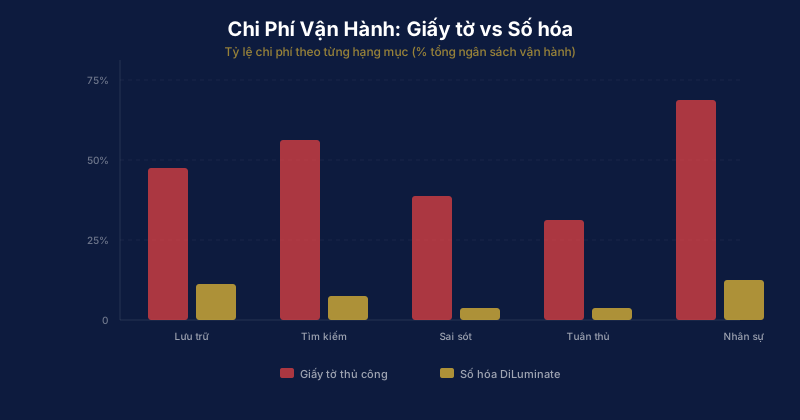
The hidden costs of paper fall into five categories most businesses never track as a line item:
- Physical storage: Office space dedicated to filing cabinets costs roughly 3–5x more per square meter than typical productive workspace.
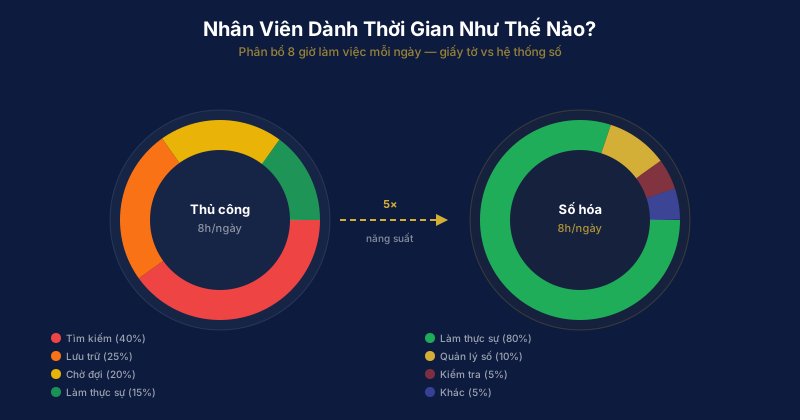
- Search and retrieval time: The average employee spends 1.5 to 2 hours per day searching for information. At even a modest salary, that is 25% of payroll going to document hunting.
- Errors and rework: Manual data entry from paper forms carries an average 1–4% error rate. Each error triggers correction cycles that compound costs downstream.
- Regulatory compliance: Storing paper documents within compliance requirements (access controls, retention periods, audit trails) requires constant manual effort.
- Staff opportunity cost: Every minute a skilled professional spends on paper tasks is a minute not spent on value-creating work.
The Real Loss: Opportunity, Not Just Cost
The financial drain is serious, but the deeper damage is strategic. When key business data sits locked in paper archives, your teams cannot run analyses, your systems cannot trigger automations, and your leadership cannot make data-driven decisions at speed. Competitors with digitized operations are simply faster, smarter, and more agile.
"A 200-person company typically spends 12–18 billion VND per year on hidden paper management costs — most without ever realizing it."
What Solving This Looks Like
The businesses that solve this problem first gain a compounding advantage. They redirect staff time to customer-facing work. They reduce physical space requirements by 60–80%. They eliminate the risk of lost or damaged records. And they unlock the data that has always been sitting in their documents, waiting to be put to work.
High-quality digitization is not simply scanning documents to PDF. That is the first step, and often the only step companies take — which is why results are disappointing. The real transformation happens when documents become searchable, structured, integrated data that flows through your existing systems.
The DiLuminate Approach
DiLuminate's enterprise digitization service goes beyond basic scanning. Our AI-powered OCR processing achieves 99.7% accuracy — not the 92–95% common with off-the-shelf tools. Every document is quality-checked through a multi-layer validation process. The resulting data is structured and delivered in formats that integrate directly with your ERP, CRM, or custom systems.
The result: a typical 200-person business sees break-even within 5 months and 400% ROI within the first year — driven by staff time savings, storage reduction, and faster decision-making.
Start With a Cost Audit
The first step is understanding what you are currently spending. DiLuminate offers a free Document Cost Audit that maps exactly how much your business loses to paper management — across all five cost categories. Most clients are surprised by the number. All are glad they did it.
Contact DiLuminate today to schedule your free audit and discover what your documents could be doing for your business instead of costing it.